
FUNDACIÓN AVINA IS EXCITED TO PARTICIPATE IN COP28
Here you can find details about important events to attend, meet the members of our delegation, read about our goals for the global climate change conference, and find out how to stay in touch.
One of Fundación Avina’s three main issues of focus is Climate Action. Based in Latin America and the Caribbean, we work alongside our allies throughout the global South to promote and expand climate justice. This year, we’re bringing two key messages on behalf of the global South to COP28:




AVINA SUPPORTS THE PARTICIPATION OF SEVERAL STRATEGIC ALLIES
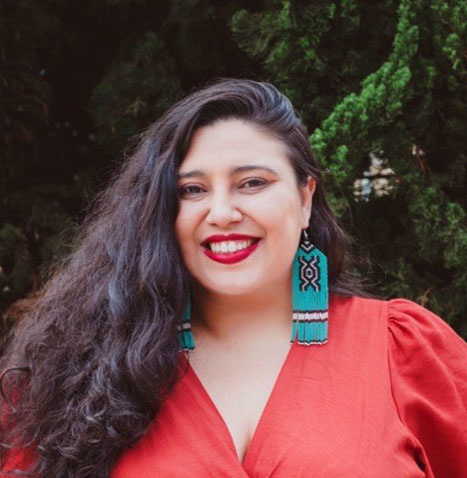
Luz Ozsorio, Guatemala, Universidad del Valle de Guatemala and Impulsouth Climate Solutions Lab studen.

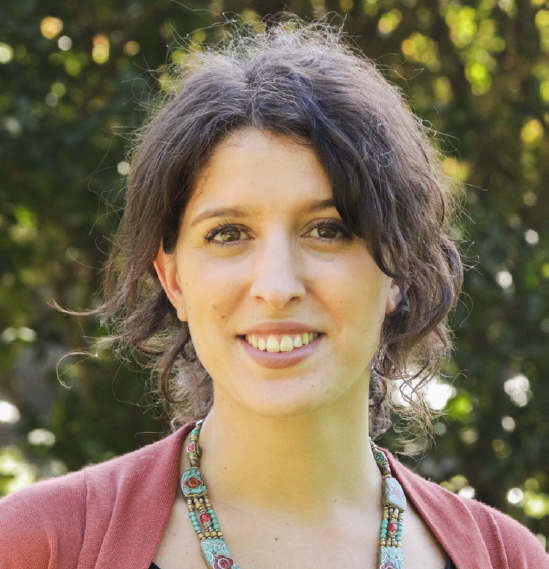
Ny Aro Andriamiarosoa, President of CliMates Madagascar and Impulsouth Climate Solutions Lab studen.
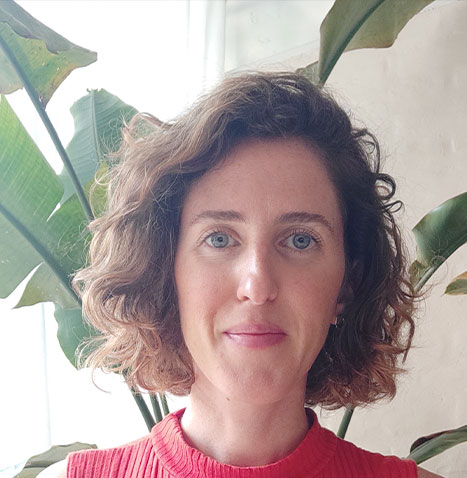
Phionah Nalubega, Programs Officer, Association of SENDEA of Uganda and Impulsouth Climate Solutions Lab studen.
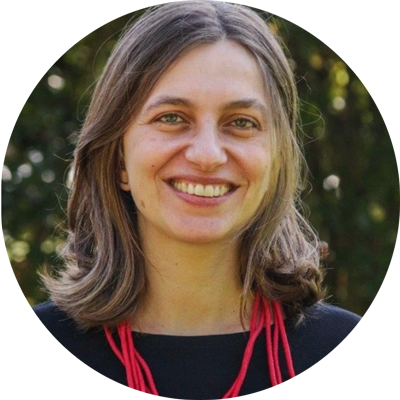
Nomayi Hatyoka, VCA-CoCCA Project Officer, The Wildlife and Environmental Conservation Society of Zambia and Impulsouth Climate Solutions Lab studen.
CONTEXT: WHAT IS AT STAKE AT COP28?
As the next COP approaches, humankind once again faces record high temperatures, devastating climate events, and the urgent need for transformational changes that challenge current power dynamics and promote people-centered solutions with a focus on the communities most vulnerable to the effects of climate change.
FUNDACIÓN AVINA’S AGENDA OF ACTIVITIES AT COP28
We are pleased to present our agenda for the 28th Conference of the Parties (COP28), with the goal of promoting climate resilience and a just transition by bringing our perspective from Latin America and the Caribbean and that of the global South.
This agenda is in line with Avina’s vision to promote a just transition by democratizing global climate decision-making spaces and nurturing the conditions needed to open up and accelerate local communities’ access to climate finance.
November 24 – Resilience Hub (online pre-COP), 10:00 (UTC-3) / 14:30 (UTC+1) / 19:00 (UTC+6)
Regional Resilience Hubs Day: Amplifying local voices in the run up to COP28
The agenda will comprise of a general introduction to the Resilience hub and the Regional Resilience Hubs. It will then provide space for the different regional stakeholders to highlight 3-5 main messages emerging from each region’s engagement this year in the context of the Regional Resilience Hubs. These messages will be connected to ongoing discussions that will be part of UNFCCC COP28 such as: The Global Goal on Adaptation, the Stocktake process or the Loss & Damage fund, among others. It will allow the Race to Resilience Campaign to acknowledge these messages and the role of Non Party Stakeholders engagement in the run up to COP28 and the increase in ambition of crucial adaptation outcomes . The session will also serve as a way to announce the start of the Resilience Hub at COP28.
Register here.
November 24th – Online – 11am GMT-3 / 3pm CET 4pm SAST
COP28: Exploring key negotiation topics and messages from civil society
This event will have the presence of Dr. Pilar Bueno, an expert in negotiation, who will address key negotiation topics such as the Loss and Damage Fund and the Global Adaptation Goal, potential key entry points, and messages from civil society.
Join us for an interactive discussion that will help us build a common understanding and strengthen our ability to collectively advocate for ambitious and meaningful progress at COP28. Interpretation will be available in English, Spanish, Portuguese, and Bahasa Indonesia.»
Register here.
December 01 – Resilience Hub Pavilion – 10.30 am
Opening session of the Resilience Hub
Event Description: soon
December 01 – Resilience Hub Pavillion, 13:30-14:30
Accelerating Indigenous Peoples and Local Communities (IPLCs) access to inclusive and appropriate finance to empower action at the local level.
Event Description: Discussing accelerating access to appropriate and inclusive climate finance for IPLCs.
Accelerating access to appropriate and inclusive climate finance is pivotal to empower transformative climate action at the local level. IPLCs play a crucial role in implementing mitigation and adaptation measures. However, constraints to access funds and appropriate sources of climate finance remain as critical bottlenecks for unlocking resources for local solutions. This event will unpack approaches to contextualize financial and climate language and information, to facilitate predictable, flexible and easily accessible finance for locally-led adaptation (LLA). The event will also explore the importance of democratizing access to climate finance and practical actions for addressing the challenges faced by IPLCs
December 01 – Resilience Hub Pavillion, 16:30-17:30
Reflecting on the Regional Resilience Hubs: What does meaningful and authentic amplification of local voices looks like?
The session will generate space for a critical discussion on what meaningful and authentic amplification of local voices looks like in practice, drawing upon and reflecting on the three years that the regional resilience hubs have been running. Local level voices from across the respective regions, as well as intermediaries, donors and support partners will be invited to discuss the topic.
The session will open up with a keynote message from the minister of environment from Egypt and will be followed by a the launch of two initiatives: i) The 2nd iteration of stories of resilience, lessons from local practitioners from GCA and ii) the launch of an event on scaling up Locally Led Adaptation in Bangladesh. Both interventions will touch upon the opportunity of these initiatives to amplify local voices and highlight potential enablers of further impact of these initiatives in global policy contexts.
These interventions will be followed by a discussion structured to allow local level voices to share their perspectives on what it means for them to engage in global discussions and events, and how best they can be supported to amplify their own voices and influence global discourse on ambitious, inclusive and transformative adaptation and resilience action at the local level. The discussion will also include insights on how to allow local voices to effectively be considered in negotiation and decision-making processes across scales and will aim to identify ‘determinants of meaningful participation’.
As the RegHubs play an important role in amplifying lesser heard voices and underrepresented constituencies from across the respective regions, this event is well situated to allow each RegHub to share key learnings and lend space for local level voices to speak directly to the topic.
December 03 – Brazil Pavilion-Auditorium 2 / 10h30 – 11h45
Women for Climate Justice: Intergenerational Dialogues between Young Activists and Women’s Leaders in Spaces of Power
If women are the main ones impacted by the effects of climate change, they are also the bearers of solutions to face this problem. In light of this, the panel seeks to connect and value the political work of women of different generations in building paths to the climate crisis. How has the political action of women of different generations made a difference in tackling climate change?
December 03
Advancing global climate action: key messages from Gloabl South philanthropy
The session will bring together foundations rooted and/or working in the global South with the aim of co-creating a shared vision among foundations working in the Global South on strategies that contribute to accelerating climate action with justice and equity as well as to map and align actions that other foundations are currently undertaking and planning in the areas identified as crucial for the Global South.
December 03 – SE Room 3, 13:15-14:45
Global Goal on Adaptation: How to bridge the gap between the global process and local progress?
Event Description: This event focuses on the discussion of bridging the gap between global adaptation goals for climate change and local achievements. While the importance of the participation of all parties and stakeholders worldwide is uncontested, the definition of global goals and measuring local achievements remains a challenge. The event is an official side event of the UNFCCC led by Helvetas and the Government of Ecuador, with the participation of the Andes Resilientes project.
Hybrid event.
December 03 – SE Room 8, 15:00-16:30
Climate Justice and Democratic Decision Making at COP: Challenges and Opportunities
In this event, we will have the opportunity to hear from representatives of traditional and indigenous communities, young people, and women from civil society, as they share their experiences and lessons to foster the engagement of local actors in decision-making spaces. Their insights will be invaluable in addressing the barriers and encouraging broader and more inclusive participation.
December 04 – Room: LDC pavilion, 9:30-10:50
Empowering the Vulnerable: Evaluating Locally Led Adaptation for Climate Finance Accountability in Least Developed Countries – Lessons learned on implementing scorecards for LLAP
Event Description: soon
December 05 – Brazil Pavilion – Auditorium 1 / 15h – 16h15
Brazil towards COP30: indigenous and local community protagonism in tackling the climate crisis.
Event Description: soon
December 05 – Children and Youth Pavilion
How do we create a viable pathway for climate finance that benefits young people from traditional communities?.
Event Description: soon
December 06 – CAF’s Pavilion, Blue Zone, Opportunity Petal, 2:00 to 3:30 p.m
We Are Green Finance, We Are The Solution
This event will be hosted by CAF as an open dialogue with international financial institutions,investment fund as and green funds to highlight their role in Latin America and the Caribbeanand analyse the impact of their requirements in the region. The dialogue will focus onopportunities for scaling-up resources and collaboration among the funds and regional entities.
December 08 – Capacity Building Hub
Capacity-building day – South-South Capacities Day.
The session aims to build on the potential of south-south collaboration and assess opportunities to pave more effective and target-oriented processes on capacity-building for transformative climate action for youth. The session will build on workshops and conversations held at African and Latin America Climate Week, culminating in this public session to share perspectives and lessons learned from southern-led capacity-building initiatives and propose innovative ideas to bring south-south cooperation on capacity-building for climate action at scale.
December 08 – Blue Zone, GCA Pavilion: Opportunity Petal, Thematic Area 4, First Floor – 9h30-10h30
Stakeholder Mapping: Launch of the Nature Accountability Map
Event Description: soon
December 08 – Canada Pavilion, 12:30-13:30
Triangular Cooperation for change: building bridges and capacities in the global south
The main goal of the event is to understand new opportunities and ways to enhance international support for capacity-building initiatives at all levels, especially by strengthening the cooperation with IDRC, and designing strategies to move forward and ensure that capacity-building reaches the next level, by fostering international cooperation.
December 08 – Perú Pavilion – 14:30-15:45
Water regulation and conservation: connecting Andean experiences in Ecuador and Peru
This event will share the initiatives undertaken in Ecuador and Peru to conserve and regulate water in mountain ecosystems, addressing changes in water availability caused by climate change that impact both human activities and the environment. Emphasizing lessons learned and contributions to global processes.
Activity in Spanish.
December 9 – Conference Connect Multipurpose Room / Green Zone / 15:00-16:30
Gender just climate transitions: global perspectives on the implications for land rights and the care economy
Perspectives on the just transition regarding the care economy.
December 10 – Resilience Hub, 13:30
Regenerative and nature-positive agriculture as an avenue to build climate resilient food systems
The session will provide a comprehensive view of regenerative food systems that can address global food security, resilience, and climate change mitigation. It will introduce systemic approaches to transform food value chains and showcase the launch of an alliance committed to sustainable rice production, demonstrating scalable actions. A focus on translating regenerative practices into actionable investments with scientific backing and supportive policies will be followed by examples of successful indigenous knowledge at various scales, emphasizing their potential for wider adoption. Finally, an open discussion will explore the path forward for scaling regenerative agriculture to build climate-resilient food systems.
December 10 – Resilience Hub, 17:30-18:30
Event: ‘Unholly Alliances’: Fostering multi stakeholder coalitions for food system transformations
This session will aim to bring along critical actors within the food value chain to discuss how to achieve coalitions for transformative and resilient food system change amid stakeholders who may traditionally not be able or choose not to come together, into unholy alliances. The round table will allow the participants to exchange experiences, challenges and lessons learned in the food sector on the importance and difficulties of generating partnerships between academia, public, private, and third sectors, to scale-up transformations in the food systems.
Hybrid event.
December 11 – Benelux pavilion – 17.30
Taking forward locally led action on climate and nature – Building partnerships, delivering change
This event will bring existing and new partners together, to share experience, unpack critical issues which may enable or stop locally led action, and hold each other accountable for action. It will be an interactive session with opportunity for audience participation and will link to other LLA events to be held across the two weeks of COP28.
ADVANCING GLOBAL CLIMATE ACTION – PHILANTHROPIC ENGAGEMENT AND ADVOCACY LEARNING INITIATIVE
The Philanthropic Engagement and Advocacy Learning Initiative will provide a platform for philanthropic organizations based in the global South and/or advocating for entities from this region to expand their influence on the global climate agenda and drive meaningful change through strategic collaboration, informed decision making, and collective advocacy efforts.
KEY ALLIES AT COP28















The Resilience Hub is the main pavilion for climate resilience and adaptation at COP, the Hub aims to drive the conversation and agenda around resilience and place locally-informed, equitable resilience solutions for people and nature at the heart of the COP process. It also aims to amplify the local voices of the most vulnerable and climate affected.
Avina plays an important role as managing partner of the Resilience Hub and leads the Latin America & Caribbean Regional Resilience Hub.
Together, We are delivering a programme of in-person and virtual engagements to bring the local voice to the global platform from May to November 2023.
To know more about LAC Regional Resilience Hub access here.
Whether you are attending COP online or in-person, the platform allows you to follow sessions, interact with attendees and learn all about the Hub, including the regional hubs which have been taking place around the world in the run-up to #COP28.
Access to the Agenda here
Join to take part in the COP 28 ResilienceHub via Virtual Platform!
Keep in touch
AVINA SUPPORTS THE PARTICIPATION OF SEVERAL STRATEGIC ALLIES
Be part of Avina’s conversations at COP28 and stay up to date on the most important events, key discussions, and news.
We also invite you to know CollaborAction (our working model)
Downloadable Material
AVINA SUPPORTS THE PARTICIPATION OF SEVERAL STRATEGIC ALLIES
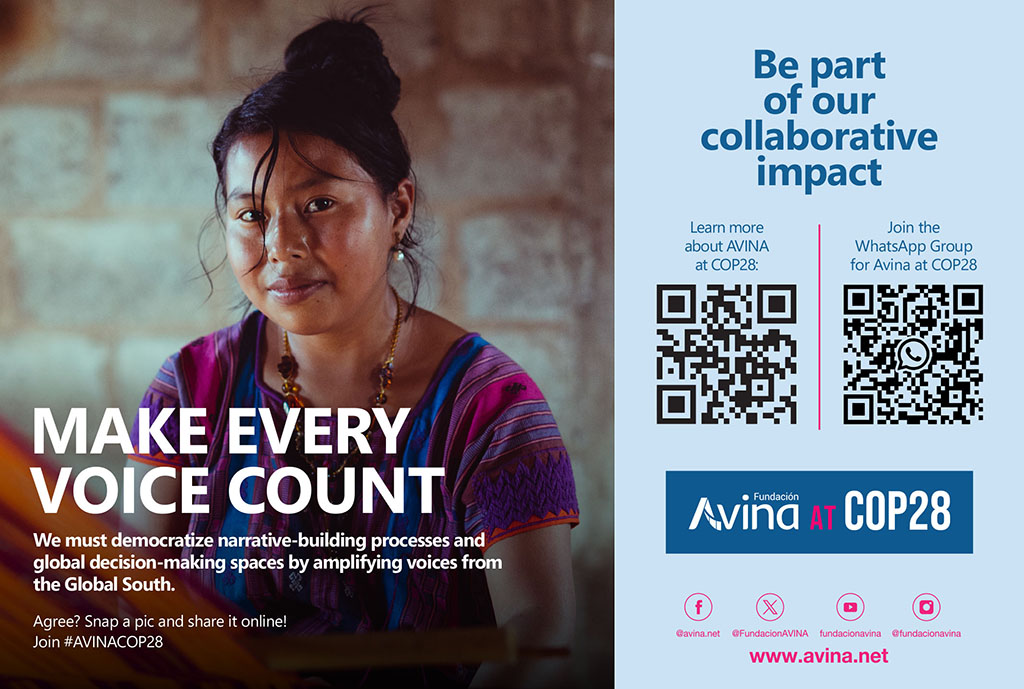
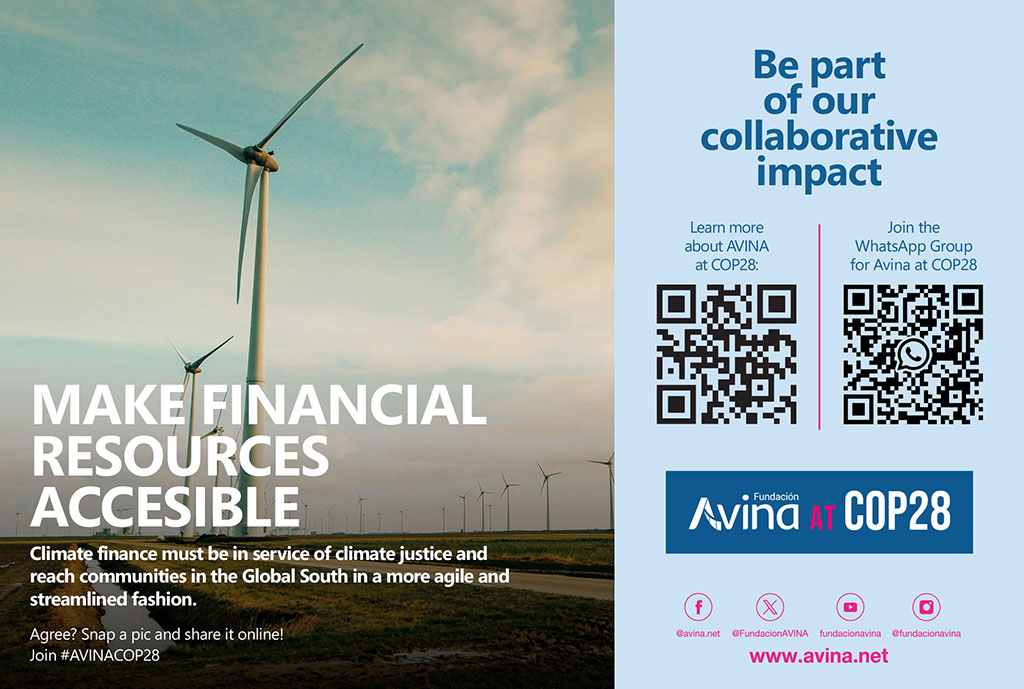
If you agree with the message, download and share it! #AVINACOP28


