Methodologies that recognize the role of inclusive recycling in forging a climate-resilient economy
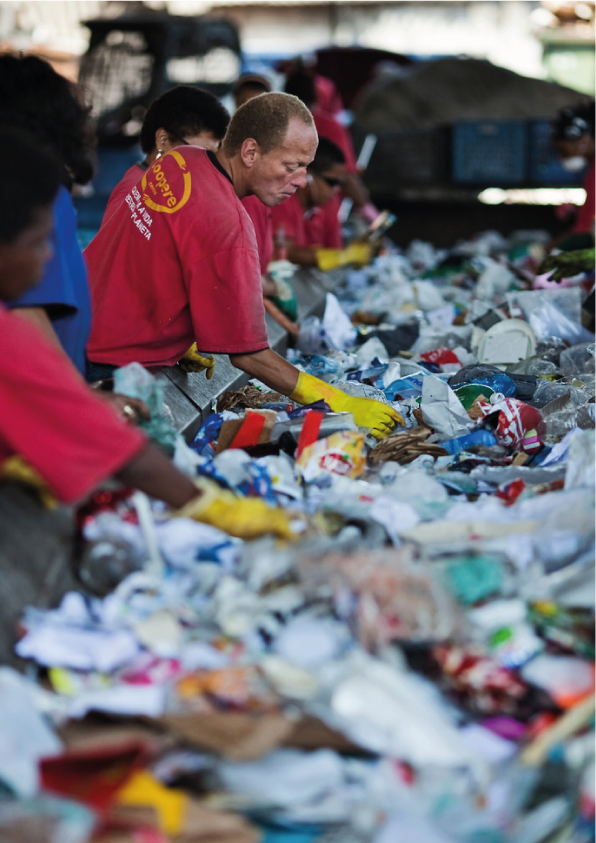
Inclusive recycling is becoming established in Brazil as a pillar of a fair, regenerative, and climate-resilient economy.
Previously, Brazil's waste management system did not have a way of measuring how recycling contributes to the climate agenda or criteria to assess the value of and provide financial compensation for recycler organizations' role in mitigating the negative effects of climate change. Brazil's reverse logistics policy also faced a challenge, in that certifying organizations were receiving a high percentage of the waste management funds intended to benefit recyclers.
In October 2024, the Brazilian government signed an agreement to adopt a methodology that measures the environmental impact of inclusive recycling and, therefore, recognizes grassroots recyclers' contribution to climate change mitigation. The Fair Ton methodology, as it is known, was designed to measure the amount of greenhouse gas emissions avoided thanks to the recovery and reuse of materials by recycler organizations. In other words, it estimates recyclers' contribution to climate change mitigation by calculating the carbon footprint of the materials they recycle. This is an important milestone on the path toward recognizing and valuing the climate contribution of this sector, which is responsible for 20% of all recycling worldwide.
The agreement, signed by representatives of the office of the National Secretary of Urban Environment and Environmental Quality, part of the Brazilian Ministry of Environment and Climate Change (MMA), and Fundación Avina, promises to expand the impact of one million Brazilian recyclers who already generate significant positive environmental benefits in their country. It also promotes a transition toward sustainable and socially equitable recycling practices.
When it comes to international treaties concerning climate change and waste management (such as the Global Plastics Treaty), one of the greatest challenges that grassroots recyclers face is demonstrating their impact. By adopting this methodology, the Brazilian government will be able to measure its impact and incorporate it into Brazil's Nationally Determined Contribution (NDC), a commitment each country makes under the Paris Agreement. The MMA plans to present the results of this initiative at COP30, in conjunction with the recycler organizations that signed the agreement, União Nacional de Catadores e Catadoras de Materiais Recicláveis (Unicatadores) and Associação Nacional de Catadores e Catadoras de Materiais Recicláveis (ANCAT).
Fundación Avina played a pivotal role in this process by bringing together key stakeholders, including Latitud R, Red Latinoamericana de Recicladores (Red LACRE, the regional network of recyclers), and Universidad Nacional de San Martín (an Argentine public research university).
A focus on innovation and a unifying vision centered around inclusive recycling facilitated the development of "Recy-Avina," a tool for measuring the avoided emissions of carbon dioxide equivalent (CO2e) and methane equivalent (CH4e). This tool was used to assess the value of recyclers' contribution to a circular and regenerative economy and climate change mitigation. Fundación Avina also assisted with the advocacy efforts to make the case to the Brazilian government that this tool should be incorporated into the Fair Ton methodology and adopted through public policy. Finally, we helped foster the construction of social capital by connecting recycler movements, governments, and experts through a unifying vision committed to sustainability.
The inclusion of recyclers in climate policies through the Fair Ton methodology demonstrates how innovation can transform complex systems. This collaborative approach between government and civil society establishes a model for other countries to integrate the just and regenerative economy agenda into their climate strategies.